Abstract
Shared experiences are fundamental to social connection, yet media consumption is increasingly solitary. While AI companions offer real-time reactions and emotional regulation, existing systems either rely on single-agent designs or lack the social awareness and multi-party interaction required to replicate authentic group dynamics. We present CompanionCast, a general framework for orchestrating multiple specialized AI agents as social collaborators within a live shared context. CompanionCast integrates multimodal event detection, rolling context caching for improved grounding, and spatial audio to enhance co-presence. We validate CompanionCast through sports viewing, a domain with rich dynamics and strong social traditions. Pilot studies with soccer fans demonstrate that CompanionCast significantly improves perceived social presence and emotional sharing compared to solitary viewing. We conclude by discussing implications and open challenges for multi-agent systems as social collaborators in shared experiences.
Type
Publication
ACM AI Leadership Summit (accepted at the ACM CHI 2026 Workshop on Human-Agent Collaboration)
Abstract
Shared experiences are fundamental to social connection, yet media consumption is increasingly solitary. We present CompanionCast, a general framework for orchestrating multiple specialized AI agents as social collaborators within a live shared context, integrating multimodal event detection, rolling context caching, and spatial audio to enhance co-presence. Validated through sports viewing, pilot studies with soccer fans show that CompanionCast significantly improves perceived social presence and emotional sharing compared to solitary viewing. This work was conducted in part during a Ph.D. research internship at Dolby Laboratories and accepted at the ACM CHI 2026 Workshop on Human-Agent Collaboration, and will be published with the ACM AI Leadership Summit.

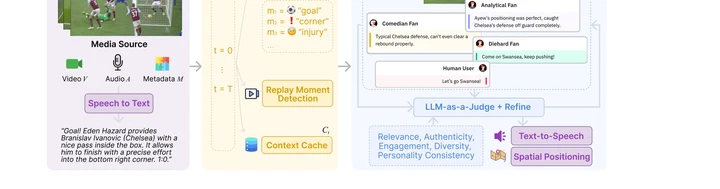 CompanionCast system workflow (adapted from Figure 1 of the paper).