Analysis
Ablation Study
We analyze the contribution of each component by systematically removing it. The persona alignment module proves most critical for maintaining individual agent quality.
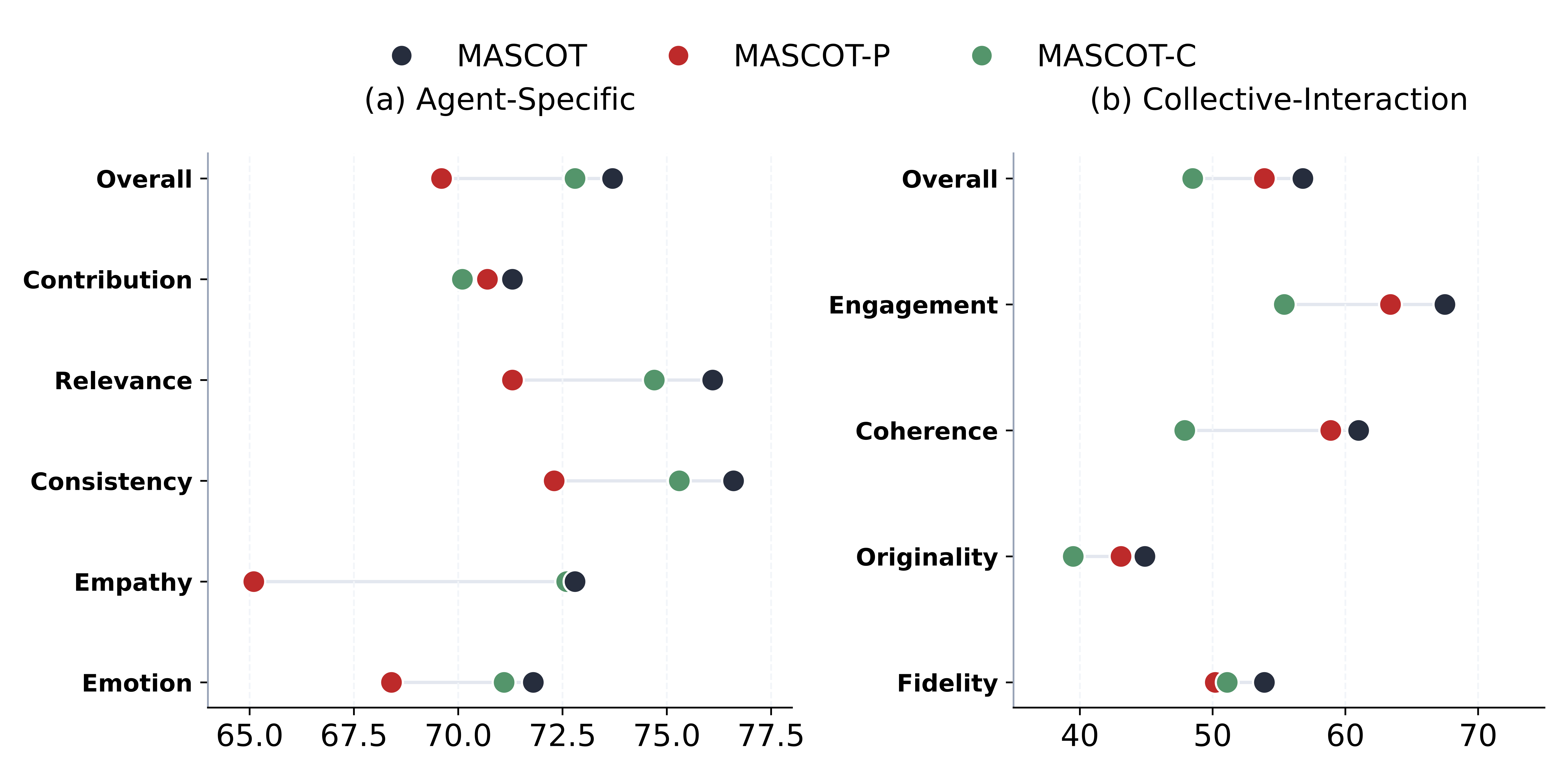
Ablation across MASCOT variants.
Key Insight
Removing persona-aware alignment (MASCOT-P) causes the largest drop, especially in Empathetic Support Quality (72.8 → 65.1) and Consistency (76.6 → 72.3). Without explicit persona grounding, agents default to generic AI-assistant behavior.
Impact of Collaborative Optimization
The MASCOT-C variant with randomized speaking orders primarily affected Social Contribution and Relevance & Coherence. The collaborative module ensures each agent builds on the previous turn rather than reacting in isolation.
Sensitivity to Model Size
We vary the backbone size of the director and speaker agents to locate performance bottlenecks.
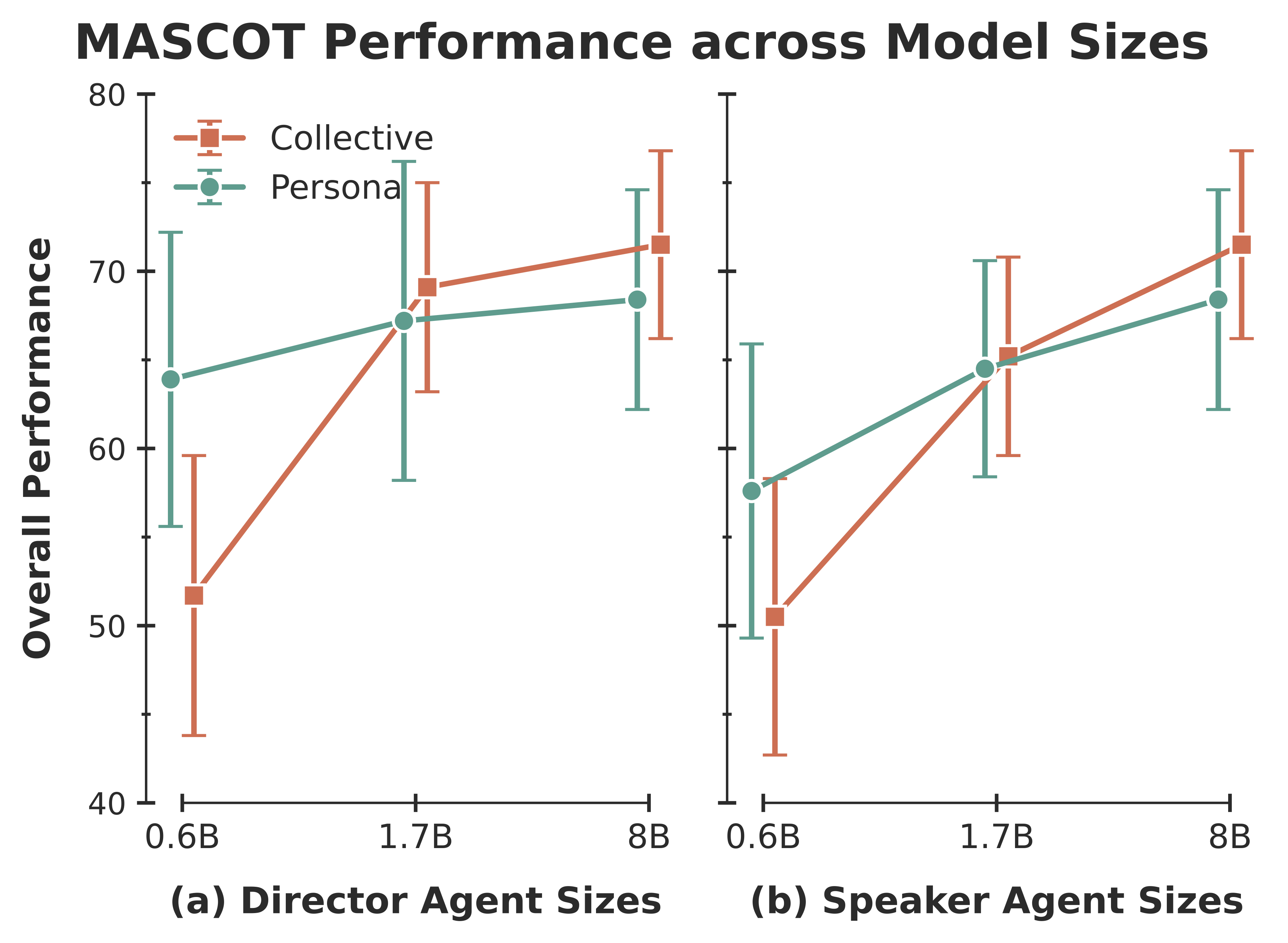
Performance sensitivity to director and speaker model size.
Takeaway
The director remains effective even when scaled down to 1.7B, but the speaker size is the critical bottleneck — a 0.6B speaker causes a significant performance drop.
Robustness Across User Personalities
To probe robustness across diverse users, the released pipeline can simulate users with Big Five (OCEAN) personality profiles (--enable-big-five, optionally --user-big-five-profile): the simulated user's replies and emotional trajectory are conditioned on the selected trait profile, and evaluation can be broken down per profile. See src/user/simulated_users.py in the repository.