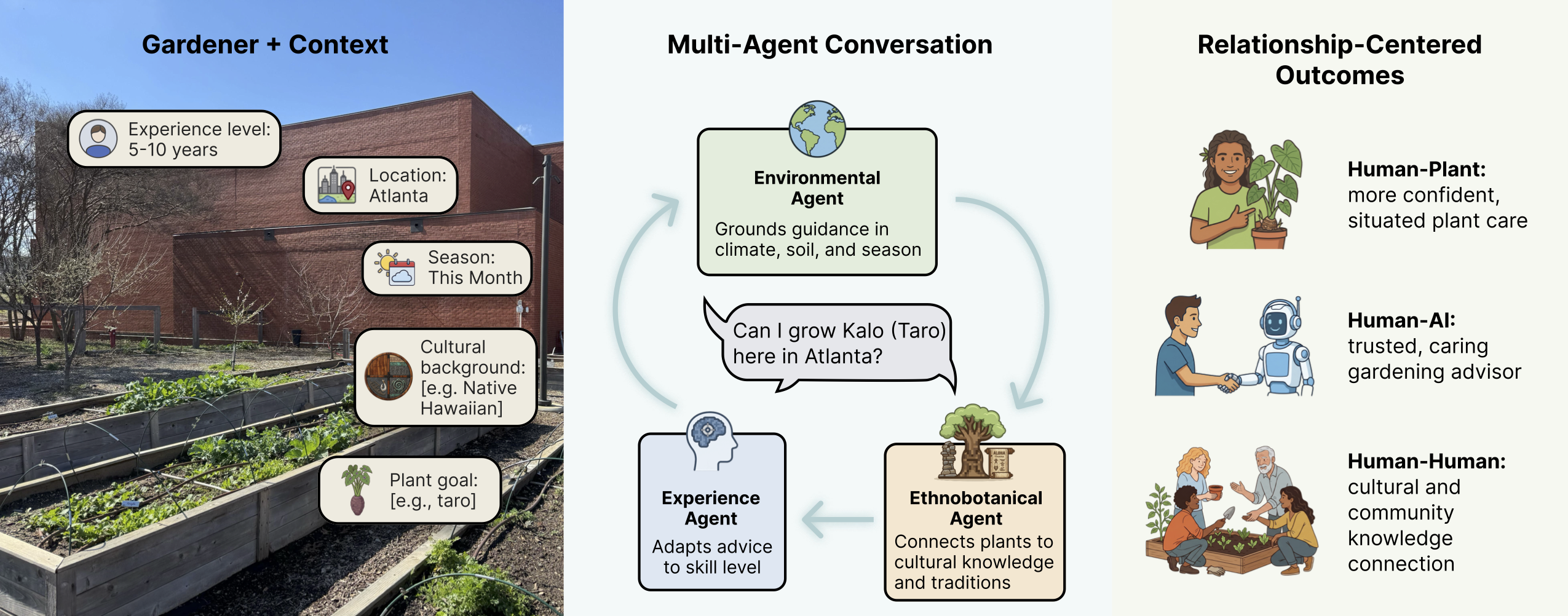
A relationship-centered multi-agent system for personalized, socio-culturally grounded gardening support — grounding guidance in your experience, your environment, and your culture.
Gardening is critical to support well-being, cultural continuity, and food autonomy, yet existing digital tools often provide generic advice that overlooks gardeners' skills, local ecologies, seasons, and cultural contexts.
We introduce CultivAgents, a relationship-centered multi-agent system for personalized, socio-culturally grounded gardening support. Grounded in ethics of care, CultivAgents coordinates multiple specialized agents: an Experience Agent that adapts guidance to users' skill levels, an Environmental Agent that grounds advice in local and seasonal conditions, and an Ethnobotanical Agent that connects plants to cultural knowledge and histories.
We evaluated CultivAgents through a three-phase mixed-methods study with domain experts (n=3), HCI researchers (n=7), and community gardeners (n=5). Results suggest that CultivAgents helped gardeners translate interest into situated action: community gardeners reported increased confidence (3.00 → 3.60), motivation (4.00 → 4.40), and trust in acting on AI advice (3.20 → 4.00). Participants valued hyperlocal ecological guidance and complementary agent perspectives, while also identifying limits in cultural specificity, ecological grounding, and agent coordination. The work advances relationship-centered AI, offering design implications for multi-agent systems that support food sovereignty, community resilience, and cultural preservation.
Roughly half of new food gardeners quit after their first season. Recent LLM-powered gardening tools make advice more portable, but face two key limitations: gardening support is expertise-intensive, and gardening is relational and situated.
Actionable guidance must account for plant biology, local climate, soil conditions, seasonality, pests, available materials, and culturally specific plant knowledge. Ungrounded advice can lead to wasted effort, failed crops, or unsafe decisions.
Useful support must balance what is environmentally feasible, appropriate to the gardener's experience level, and meaningful within their cultural or community context. Most LLM systems collapse these dimensions into generic advice.
Displaced and diaspora gardeners lose more than logistics — they lose tacit knowledge. Single-agent designs overlook the social, ecological, and cultural relationships that shape gardening practice.
Each agent owns a complementary dimension of personalization. A lightweight LLM selector routes every user turn to the right voices, and the agents respond in short, color-coded rounds.
SelectorGroupChatOn first visit, a short onboarding modal collects four inputs that personalize every agent's system prompt for the rest of the session.
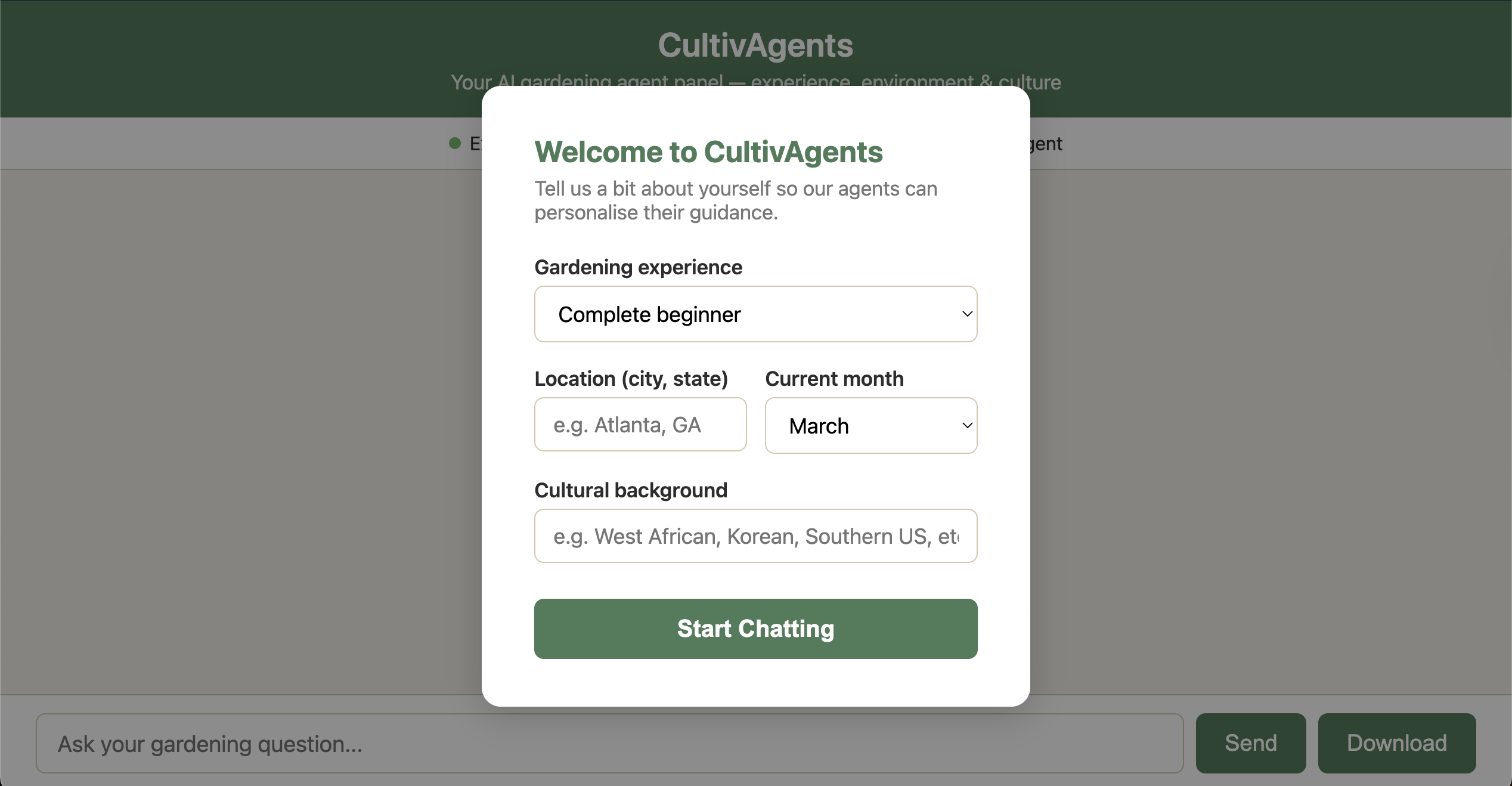
Onboarding. Four inputs — experience level, location, current month, and cultural background — feed every agent's system prompt as structured context.
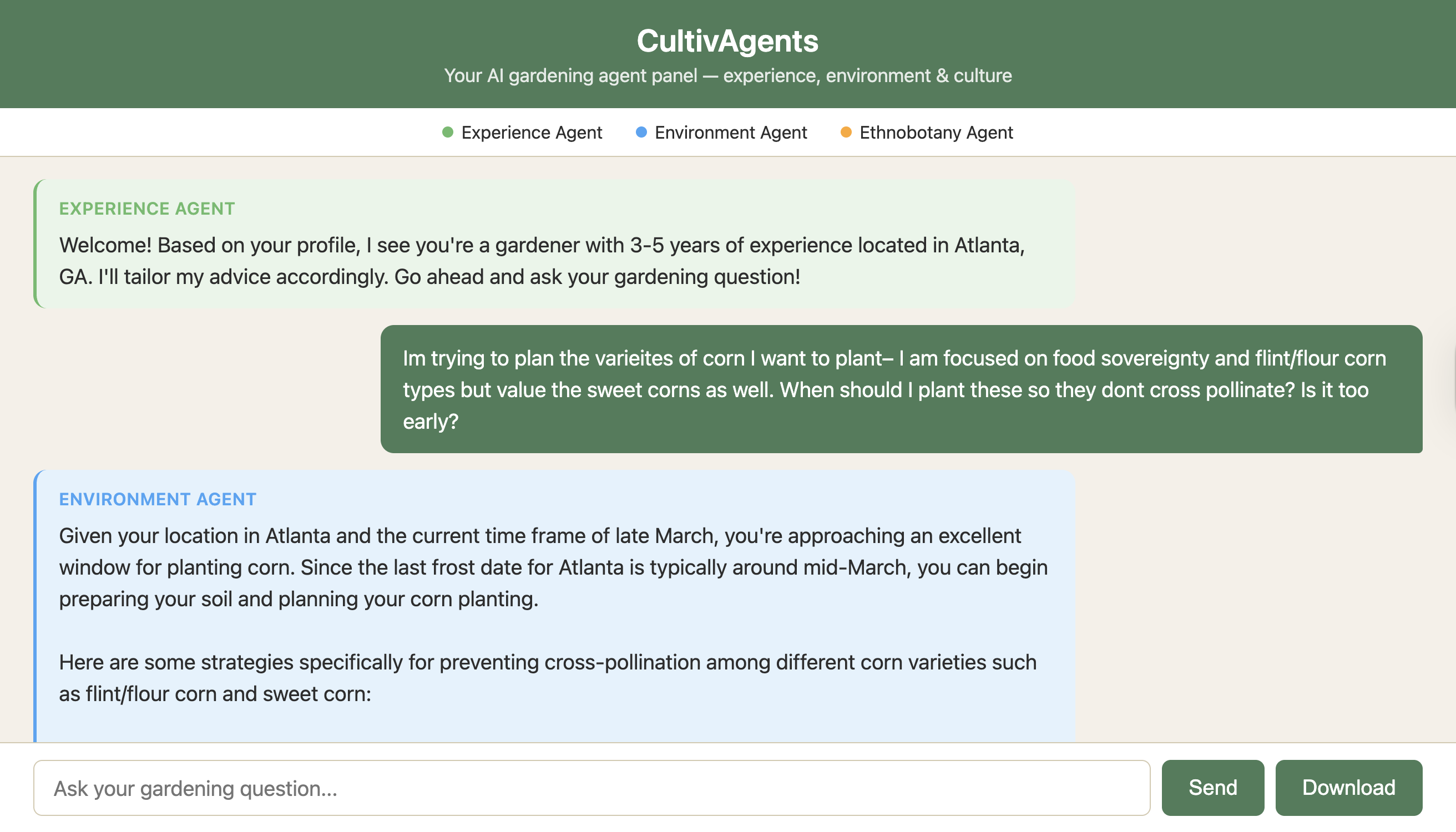
Color-coded turns. Green (Experience), blue (Environmental), orange (Ethnobotanical), streamed live over WebSocket with Markdown rendering and full-transcript export.
Each agent has a base system prompt defining its persona. At session initialization, the user
profile ⟨e, ℓ, m, c⟩ is serialized into structured context and concatenated with
each agent's prompt. At each turn, an LLM-based selector chooses the next eligible speaker
(excluding the previous speaker to encourage complementary perspectives). Each round
terminates after k=3 agent messages, then the round-level selector history resets to
bound context growth while preserving conversational continuity.
The frontend is a single-page web app that talks to a FastAPI backend over a persistent WebSocket. The system is containerized via Docker and ships as a public, try-it-now demo.
We evaluated CultivAgents via a three-phase mixed-methods approach with domain experts (n=3), HCI researchers (n=7), and community gardeners (n=5). We observed measurable lifts in confidence, motivation, and trust — anchored to hyperlocal grounding.
Neighborhood-scale soil and climate detail was the single biggest lever on confidence — moving plants from a digital abstraction to a situated living entity.
Environmental Agent: 4.80/5 location relevance · 4.40/5 seasonal accuracy.
Even users who did not arrive with an explicit cultural profile used the Ethnobotanical Agent to explore ancestral knowledge as a lens for urban food production.
Ethnobotanical Agent: 4.20/5 cultural relevance · 4.00/5 authenticity & respect.
Trust and care emerged from relevant, respectful, actionable guidance — but full companionship will require memory, continuity, and longer-horizon care.
Companionship rating: 2.40/5 · A clear roadmap for continuity.
Onboard with your location, month, and cultural background — and watch three agents coordinate guidance for what you're trying to grow. No install, no signup.
@article{cultivagents2026,
  title   = {CultivAgents: Cultivating Relationship-Centered Multi-Agent Systems for Personalized Gardening},
  author  = {Wang, Yiyang and Reilly, Moeiini and Johnson, Britney and Yan, Kefei and Cabral, Alex and Hester, Josiah},
  year    = {2026},
  note    = {Preprint},
  url     = {https://cultivagents.onrender.com/}
}